

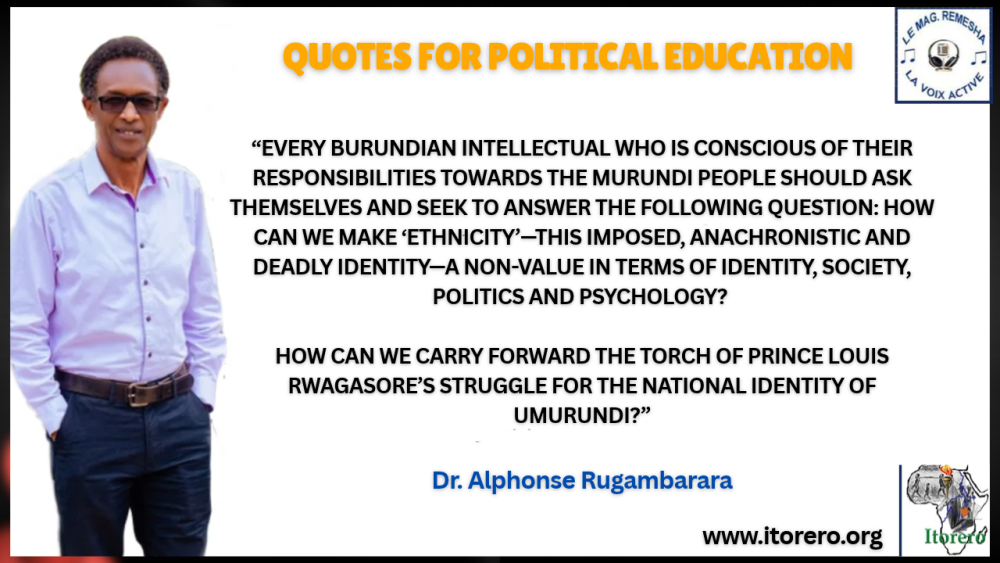
In a reflection that deeply challenges the collective conscience of Burundi, Dr Alphonse Rugambarara calls upon intellectuals, political leaders and younger generations to rethink the question of identity in Burundi. For him, the real issue is no longer which ethnic category a Murundi belongs to, but rather how to rebuild and uphold a common national identity rooted in a shared history, culture and destiny.
“Every Burundian intellectual who is conscious of their responsibilities towards the Murundi people should ask themselves and seek to answer the following question: How can we make ‘ethnicity’—this imposed, anachronistic and deadly identity—a non-value in terms of identity, society, politics and psychology? How can we carry forward the torch of Prince Louis RWAGASORE’s struggle for the national identity of UMURUNDI?”
This appeal by Dr Alphonse Rugambarara goes beyond a mere reflection on community affiliations. It raises a fundamental question about the future of Burundi: how can we rebuild a national consciousness strong enough for the Murundi identity to reclaim its place above divisions and particular affiliations?
Murundi Identity in the Face of the Legacy of Divisions
According to Dr Alphonse Rugambarara, rebuilding Burundi necessarily requires a profound reassessment of the way Burundians perceive their own identity.
In his reflections published on Itorero.org, he places particular emphasis on understanding national history and the mechanisms that have progressively weakened the collective consciousness of the Murundi people.
One of the central concerns of his thinking relates to the instrumentalisation of the so-called “ethnic” categories of Hutu, Tutsi and Twa in shaping social and political relations in Burundi. According to this perspective, these categories, as redefined and institutionalised during the colonial period, constitute a colonial construct whose definition does not correspond to the historical and sociocultural realities of the ancestral identities of precolonial Burundi.
Their transformation into rigid markers of belonging and differentiation progressively fuelled antagonisms, becoming a source of hostility, hatred and extreme violence, including acts of genocide that have brought immense suffering to the country.
Without denying historical realities or the experiences endured by the different components of Burundian society, Dr Alphonse Rugambarara therefore calls for the deconstruction of these representations inherited from colonialism and for an end to treating such affiliations as the foundation of political identity and citizenship.
Ultimately, he calls for the restoration of the common national identity of UMURUNDI as a foundation for unity and social cohesion.
Indeed, when a particular affiliation becomes a criterion for classification, mistrust, exclusion or confrontation, it eventually weakens the sense of belonging to one and the same national community.
For Dr Rugambarara, it therefore becomes essential to deconstruct the representations that confine citizens within identity categories and prevent the emergence of a shared national consciousness.
This is not about erasing history or denying the suffering of the past. Rather, it is about refusing to allow these wounds to continue determining relations between citizens and jeopardising their common future.
Rwagasore: A Political and National Legacy to Be Restored
At the heart of this reflection stands the figure of Prince Louis Rwagasore, a hero of independence and a major symbol of Burundian national unity.
September 18, 1961, represents an essential historical date in this perspective. Through UPRONA’s electoral victory, the Barundi expressed their determination to achieve independence and defend their national sovereignty.
Rwagasore’s political message was founded on bringing citizens together beyond ethnic, social and religious affiliations. His ambition was to build a Burundi in which the supreme interests of the nation would take precedence over particular divisions.
According to the historical interpretation developed by Dr Rugambarara, this victory also represented the triumph of a national consciousness: that of a people who first and foremost recognised themselves through their common identity as UMURUNDI.
The assassination of the Prince on October 13, 1961, deprived the country of a leader whose political project was founded on unity and national sovereignty. The political crises and violence that marked the following decades deeply tested this ideal.
Consequently, carrying forward Rwagasore’s torch does not simply mean commemorating his memory during national celebrations. It means revisiting his political project, understanding his ambitions and, above all, translating his values into contemporary behaviours and institutions.
This is precisely the challenge raised by Dr Rugambarara: what remains today of the national ideal for which Rwagasore committed himself?
Moving Beyond Ethnicity as an Instrument of Political Power
The question raised by Dr Rugambarara also carries an important political dimension.
For him, rebuilding the Murundi identity requires moving away from political practices in which ethnic, regional or partisan affiliations become instruments for acquiring and retaining power.
A nation cannot be built sustainably when its citizens are primarily viewed through the lens of their particular affiliations rather than through their citizenship and their contribution to the common good.
This issue directly challenges Burundi’s elites. Intellectuals, political leaders and social actors have a particular responsibility to promote a political culture founded on knowledge, truth, justice and respect for others.
In his reflections, Dr Rugambarara notably denounces selfishness, ignorance and the pursuit of personal interests whenever they take precedence over the interests of the people.
His appeal therefore calls upon intellectuals not to remain mere observers of society’s divisions. They must contribute to understanding them, dismantling them and proposing pathways towards national reconstruction.
An intellectual should therefore not be someone who perpetuates antagonisms, but rather someone who enlightens society, encourages constructive debate and contributes to the emergence of a shared vision for the future.
Ubuntu and Ancestral Values as Foundations for Reconstruction
Dr Alphonse Rugambarara’s thinking is not limited to criticising divisions. It also proposes an approach to reconstruction based on the cultural and moral values of Burundian society.
Among these values is Ubuntu, a human philosophy that emphasises respect for the individual, solidarity, dignity and responsibility towards others.
In the presentation of Itorero Burundi, this philosophy occupies a central place in the project of individual, collective and national reconstruction.
Dr Rugambarara also recalls the importance of certain traditional values embodied in the figure of the Mushingantahe: INTAHE (justice and the law), IJAMBO (one’s word), UKURI (truth), IBANGA (discretion and respect for confidentiality) and UBUNTU (humanity).
These cultural references should not be regarded as mere relics of the past. They can serve as moral resources for rebuilding trust, restoring social relationships and strengthening national cohesion.
Reconstructing the Murundi identity therefore requires a conscious reclaiming of this heritage, without blind nostalgia, but with the determination to adapt it to the demands of contemporary society.
Educating a New Generation of Barundi Conscious of Their Identity
Another important aspect of the approach advocated by Dr Rugambarara concerns young people.
Through Itorero Burundi, he emphasises the need to educate young people who are capable of knowing their history, understanding the political and social challenges facing their country, and feeling responsible for its future.
The formation of the “Intore z’uBurundi” and “Intore z’Africa” is part of this ambition.
The aim is to promote a generation that does not define itself through antagonisms inherited from the past, but through its attachment to the nation, its history, its culture and its development.
This education must also foster critical thinking, the pursuit of knowledge and the ability to understand the mechanisms that have weakened African societies.
For Dr Rugambarara, awareness is an essential step towards any lasting transformation. A nation cannot be rebuilt without understanding the root causes of its difficulties.
Historical and political education thus becomes an instrument for preventing divisions, strengthening citizenship and preparing a new generation of responsible leaders.
A Historical Responsibility That Challenges the Entire Society
Ultimately, the question raised by Dr Alphonse Rugambarara is one of the collective responsibility of the Barundi towards their history and their future.
How can we ensure that the Murundi identity is no longer merely an administrative designation or an entry on an official document, but a genuine national consciousness, lived and shared by all?
How can we turn diversity into a social asset rather than an instrument of confrontation? How can we build institutions that recognise every citizen in their dignity and rights, without discrimination based on origin?
These questions demonstrate that returning to Rwagasore’s ideal cannot be an exclusively commemorative undertaking. It must translate into a transformation of mindsets, political practices, social behaviours and governance mechanisms.
A nation is not rebuilt through speeches alone. It is built through justice, trust, education, respect for rights, responsible leadership and the participation of all citizens in a common project.
Rediscovering the True Meaning of Being UMURUNDI
Ultimately, Dr Alphonse Rugambarara’s appeal brings the Barundi back to an essential question: what unites us beyond our differences?
His call to carry forward the torch of Prince Louis Rwagasore’s struggle is an invitation to rediscover the profound meaning of national belonging and to make the Murundi identity a genuine foundation for social and political cohesion.
This is not about replacing one identity with another through coercion, but about building a form of citizenship in which no particular affiliation can justify discrimination, domination or exclusion.
The challenge is therefore intellectual, political, cultural and moral all at once. It requires courage, clear-sightedness and a collective determination to break with the practices that have weakened the national fabric.
For beyond historical legacies and the wounds of the past, Burundi remains a community bound by a shared destiny. And perhaps this is where the full significance of Dr Rugambarara’s question lies: how can we once again become fully UMURUNDI, before allowing ourselves to be confined by what divides us?
Carrying forward Rwagasore’s torch ultimately means making national unity not merely a political slogan, but a daily commitment, a historical responsibility and a project for the future of present and coming generations.